Plymouth is one of the most geographically varied towns SSMC serves. A single property in Plymouth might back up to a cranberry bog, sit 400 feet from a kettle pond, border a conservation trail that deer use nightly, or front a tidal creek off Plymouth Harbor. That variety — while what makes Plymouth a great place to live — is also what creates some of the highest mosquito and tick pressure on the South Shore.
This post covers what Plymouth homeowners are actually dealing with, how SSMC’s exterior treatment program works for the area, and what a full season looks like start to finish.

Plymouth’s Landscape and Why It Creates Mosquito and Tick Pressure
Water Everywhere
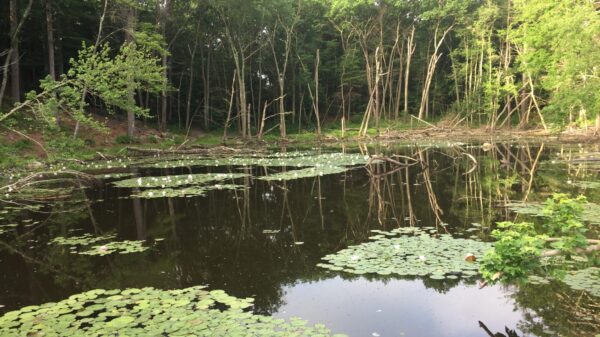
Plymouth has more named ponds and lakes than most Massachusetts towns — Federal Furnace Pond, Billington Sea, College Pond, Halfway Pond, Morton Park Pond, and dozens of smaller unnamed kettle ponds scattered throughout town. Add the cranberry bog operations that cover thousands of acres in the western and central parts of Plymouth, the tidal marshes along Plymouth Harbor, and the wetland corridors that run between neighborhoods, and you have a town with standing and slow-moving water in almost every direction.
Mosquitoes need standing water to complete their life cycle. Plymouth’s landscape provides abundant breeding habitat throughout the warm season. The species homeowners deal with most in Plymouth are consistent with the rest of Plymouth County:
- Culex pipiens — the common house mosquito, most active at dusk and dawn, the primary vector for West Nile Virus in Massachusetts
- Aedes vexans — a floodwater species that surges after rain events and is an aggressive daytime biter
- Coquillettidia perturbans — a marsh-associated species that peaks in late summer and is linked to EEE transmission in MA
None of these are meaningfully controlled by store-bought traps or citronella candles at any yard-wide scale. Professional exterior treatment is what actually moves the needle.
Wooded Lots and Tick Habitat
Outside of the coastal villages and older downtown neighborhoods, Plymouth is a large-lot, heavily wooded town. The stretch from Cedarville through South Plymouth out toward the Carver border is some of the most tick-dense suburban territory on the South Shore. Conservation land abuts backyards throughout. The Pine Hills neighborhood, Long Pond Road corridor, and much of west Plymouth are characterized by scrub oak, pitch pine, and mixed hardwood — exactly the habitat where blacklegged ticks thrive.
Blacklegged ticks (Ixodes scapularis) are the species responsible for Lyme disease, anaplasmosis, and babesiosis in Massachusetts. They don’t fly or jump. They sit at the tips of low vegetation and wait for a host to brush past. White-footed mice are their primary reservoir for Lyme-causing bacteria. Deer carry adult ticks across the landscape. Plymouth has dense populations of both.
Plymouth County has consistently ranked among the highest Lyme disease incidence counties in Massachusetts. For homeowners in Plymouth with wooded borders, that’s not an abstract statistic — it reflects real exposure risk in everyday yard use.e counties in Massachusetts. For homeowners in Plymouth with wooded borders, that’s not an abstract statistic — it reflects real exposure risk in everyday yard use.
How the SSMC Exterior Program Works
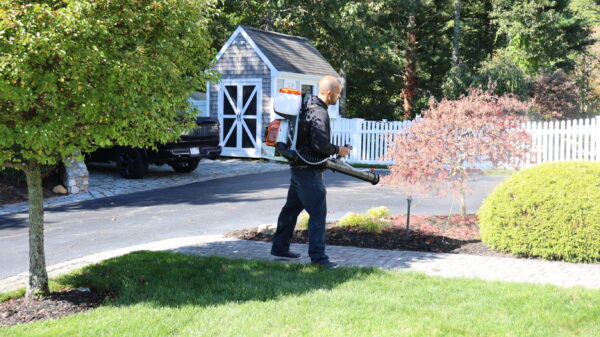
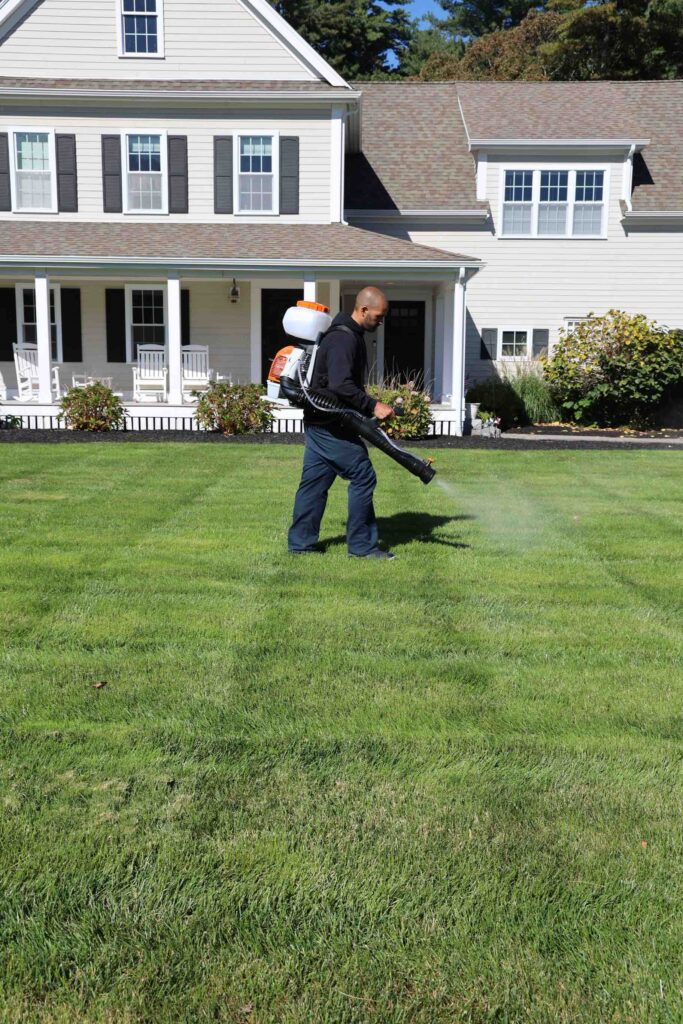
SSMC treats mosquitoes and ticks together as a single bundled exterior program. Every visit addresses both. There is no mosquito-only or tick-only option — the two programs are designed to work as a unit, applied in one technician visit on the same treatment schedule.
The standard program is eight visits across the season, spaced on a three-week interval, beginning in late April or early May and running through October.
What Gets Treated
Every treatment visit covers the full exterior of the property — the entire yard, not selected zones. That includes:
- Open lawn areas — the full turf surface from house to property edge
- Perimeter shrubs and ornamental plantings — where adult mosquitoes rest during the day
- Low-hanging tree canopy along the lawn edge — a primary adult mosquito harborage zone
- Ground cover beds — pachysandra, vinca, English ivy, and similar plantings hold moisture and provide dense resting cover
- Wooded borders and transition zones — the lawn/wood interface where tick density is consistently highest
- Stone walls — a Plymouth landscape staple and a well-documented tick hotspot, as gaps and cavities shelter white-footed mice
- Under decks and around play equipment — particularly when adjacent to or shaded by wooded areas
- Leaf litter accumulation zones — along fences, at foundation edges, anywhere debris collects
The full-property approach matters because biting insects don’t stay in one zone. Mosquitoes move across open lawn. Ticks hitchhike on animals that cross the whole yard. Treating the complete exterior — not just the edges — is what produces yard-wide results.
Why Three Weeks
The three-week interval is calibrated to the mosquito life cycle. From egg to biting adult takes roughly 10–14 days under typical summer conditions in southeastern Massachusetts. Treating every three weeks means each application addresses the adult population before the next generation fully emerges. Longer gaps allow populations to rebuild between visits.
The same interval keeps tick harborage zones in a consistently treated state throughout the season, maintaining residual protection in the highest-pressure areas of the property.
Organic Options
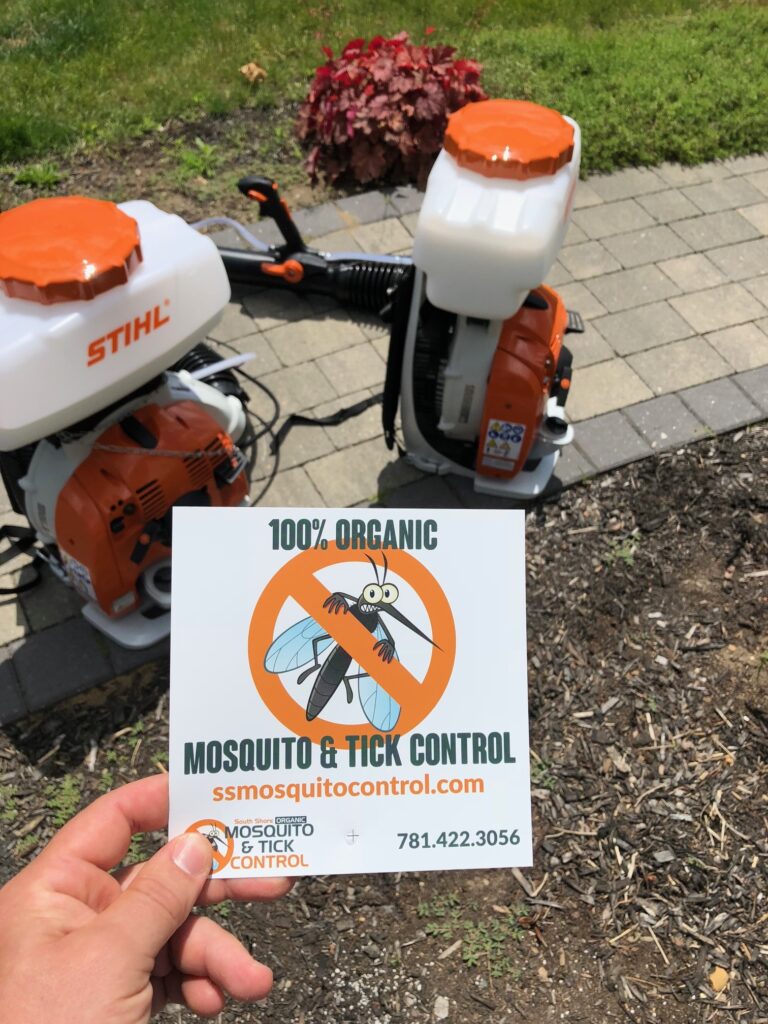
For Plymouth homeowners who prefer botanical formulations, SSMC offers organic treatment using chrysanthemum-derived pyrethrins and related natural active ingredients. The full-property coverage remains the same — what changes is the active ingredient. Organic formulations have a somewhat shorter residual period per application than synthetic pyrethroids, which some Plymouth families prefer for properties near ponds, conservation land, or where young children and pets spend significant time outdoors.
Plymouth-Specific Considerations
Conservation Land Borders
Conservation land adjacency is one of the most common scenarios in Plymouth — and the scenario where professional exterior treatment matters most. You have no control over what’s happening on the other side of your property line. Untreated wooded conservation land is a continuous source of mosquito and tick pressure. SSMC’s full-property treatment creates a consistently maintained exterior barrier on your side, significantly reducing activity in the areas of your yard you actually use.
Cranberry Bog Proximity
SSMC technicians are trained on setback requirements from water bodies and agricultural operations. If your property is immediately adjacent to active bog operations or open water, the technician will assess the situation on the first visit and treat accordingly within applicable Massachusetts pesticide application regulations. Barrier spray is applied to vegetation — not directly to water.
Ponds and Water Features
For properties with ponds or ornamental water features, BTi-based mosquito dunks can be used directly in the water to address breeding at the source. This is a useful supplement to the exterior barrier program for Plymouth properties where standing water is on-lot and can’t be eliminated.
Large Lots in West Plymouth
Plymouth’s rural western sections — Federal Furnace Road, Halfway Pond Road, the Bourne Road corridor — include a number of larger residential parcels that SSMC serves. Lot size is factored into the quote for properties significantly above the standard residential footprint.
Pricing and How to Save
The combined seasonal program is priced per treatment visit, with most Plymouth residential properties falling in the standard residential tier.
Prepay discount: Signing up and paying for the full season earns a 15% discount off the total. For Plymouth homeowners who plan to run the program through the full season, this is the most straightforward way to reduce the cost.
Referral program: SSMC’s refer-a-neighbor program gives you a $75 credit when someone you refer signs up, and the person you refer gets $50 off their first season. In Plymouth neighborhoods where several properties share the same woodline, pond border, or conservation edge, coordinating with neighbors makes both practical and financial sense — adjacent treated properties reinforce each other’s protection by reducing the shared source population.
Frequently Asked Questions from Plymouth Homeowners
My property borders conservation land. Does that affect how treatment works? It’s actually one of the most important reasons to run a professional exterior program. Conservation borders are a continuous pressure source. SSMC’s full-property treatment covers your entire exterior — not just the edge — which is what’s needed to counter ongoing pressure from adjacent untreated land.
We have a cranberry bog nearby. Are there treatment restrictions? SSMC follows all Massachusetts setback and buffer requirements for pesticide application near water bodies and agricultural operations. The technician will review the property on the first visit and treat accordingly.
We have a pond on our property. What about the water itself? Barrier spray is applied to vegetation, not open water. For the pond itself, BTi-based dunks used directly in the water address breeding at the source and work well alongside the exterior program.
How quickly will we notice a difference? Most Plymouth customers notice a measurable reduction in mosquito activity within a few days of the first treatment, with continued improvement over the first two to three visits as the program works through successive mosquito generations. Tick pressure is less immediately visible but tends to show up in fewer ticks found on family members and pets after time outdoors.
Do you treat large properties in west Plymouth? Yes. Lot size is factored into the quote for larger parcels. The full-property coverage approach applies regardless of lot size — larger properties are quoted accordingly.
Getting Started
The right time to start is before you need it. For Plymouth homeowners, that means getting on the schedule in March or early April — before mosquito emergence and before nymphal tick season peaks around Memorial Day.
To get a quote for your Plymouth property, visit the Plymouth service area page or the contact page to request a callback. The quote process is simple — lot size and proximity to wooded or wet areas are the main inputs. Every program includes both mosquito and tick treatment as a bundled exterior service.
SSMC has been running exterior treatment programs across Plymouth since 2012. The town’s geography — ponds, bogs, wetlands, conservation land, large wooded lots — is well-understood territory for the crew.
South Shore Mosquito & Tick Control provides exterior mosquito and tick treatment across Plymouth and 42 additional towns on the South Shore and Cape Cod. View all service areas →